
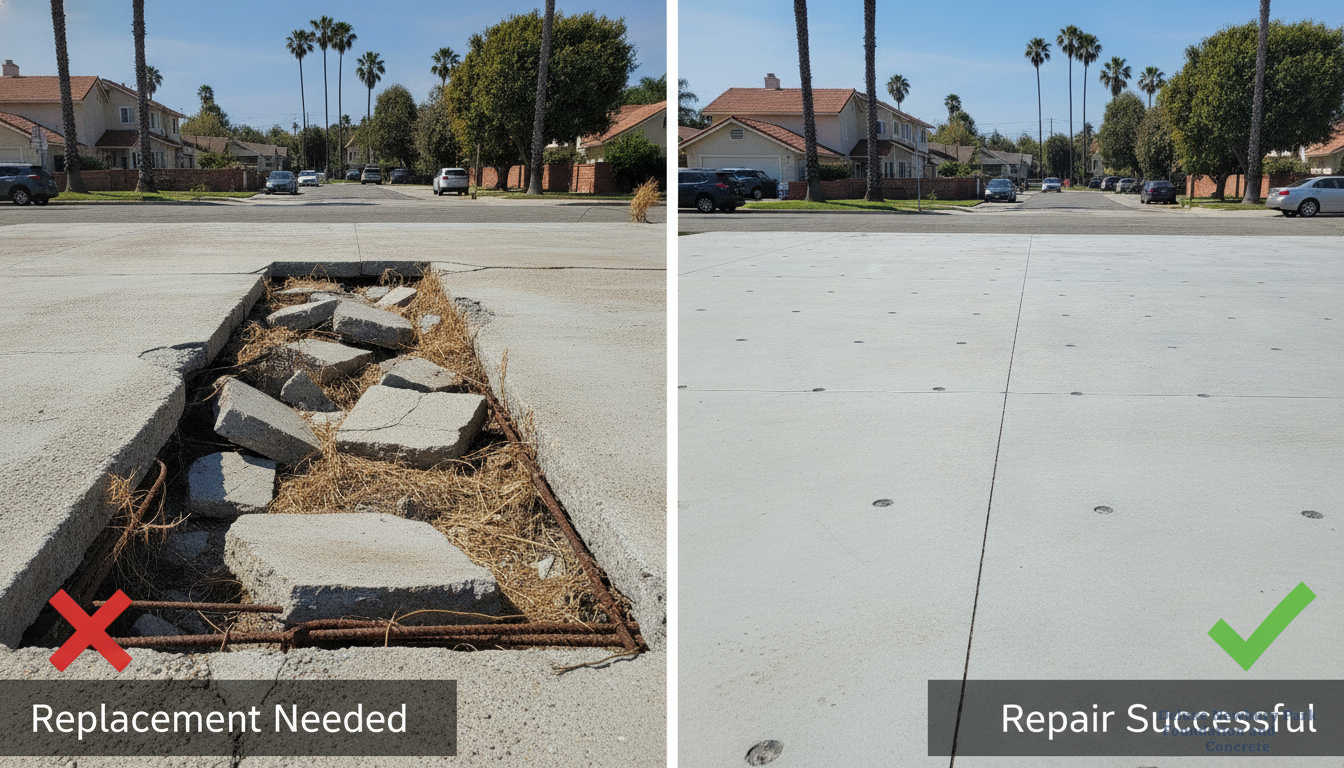
The Big Question: Repair or Replace?
When a homeowner in Newbury Park discovers that their slab foundation is cracked, sunken, or heaving, the first question they usually ask is whether the slab can be saved or whether it needs to come out entirely. The answer depends on several factors — the extent of damage, the condition of the concrete itself, the behavior of the soil beneath it, and the cost comparison between the two approaches.
At Deluxe Newbury Park Foundation and Concrete, we are frequently asked to evaluate this question for homeowners throughout the Conejo Valley. In the vast majority of cases we see, targeted repair is not only possible but is the better long-term value. However, there are situations where replacement is the right call, and we believe in giving homeowners honest guidance rather than defaulting to the more expensive option. This post walks through the key considerations.
How Slab Damage Happens in Newbury Park
Understanding why slabs fail in this region helps clarify what kind of repair is appropriate. Newbury Park and the surrounding Conejo Valley communities sit on expansive clay soils — a soil type that absorbs water and swells in volume, then contracts as it dries out. This cycle repeats every year with the rainy and dry seasons and can be amplified by irrigation patterns, roof drainage, and changes in landscaping.
The result is a foundation that is constantly being pushed, pulled, and shifted in small increments. Over years and decades, those small movements accumulate into visible problems: sections of the slab settle into voids created by shrinking soil, other sections heave upward when clay moisture content spikes, and cracks develop at the stress points between moving and stationary areas of concrete.
Additional factors specific to Newbury Park include the region's seismic exposure, which can cause sudden differential movement, and the area's hillside topography in neighborhoods like Lake Sherwood, where water management on sloped lots is particularly important for slab stability.
When Slab Repair Is the Right Choice
Repair is appropriate in the majority of residential slab situations when the following conditions are present:
- Settlement without major structural cracking: If a section of the slab has sunk but the concrete itself is still intact and in good condition, foam lifting or mudjacking can restore the elevation quickly and cost-effectively. Our slab foundation repair team uses high-density polyurethane foam that cures in minutes and returns the surface to use the same day.
- Isolated cracking without full-depth displacement: Cracks that run through a section but have not caused large chunks of the slab to shift out of plane can often be stabilized with epoxy or polyurethane injection combined with surface patching. See our foundation crack repair service for details on how we handle structural and cosmetic cracks.
- Heaving limited to one or two slab panels: When expansive clay pushes a localized section upward, grinding or careful undercutting of the affected panel is sometimes combined with improved drainage to relieve the moisture pressure causing the heave.
- Concrete still structurally sound: The key variable is whether the concrete itself retains adequate compressive strength. Slab concrete that sounds solid when tapped, does not crumble at crack edges, and is not delaminating from below is a good candidate for repair.
Repair is almost always significantly less expensive than replacement. Replacement requires demolition, disposal of the old concrete, re-compaction of subgrade, rebar installation, pouring, curing time — often two weeks or more — and then refinishing of interior flooring and finishes above. A foam lifting repair for the same area might take a single afternoon.
When Replacement Becomes Necessary
There are circumstances where the concrete itself has deteriorated past the point where repair is structurally sound or cost-effective:
- Severe widespread cracking and spalling: When a slab has shattered into multiple sections with large offsets in every direction, the concrete matrix is compromised and lifting the pieces individually will not restore a stable surface.
- Rebar corrosion causing concrete delamination: If water infiltration has reached the steel reinforcement and caused it to rust and expand, the concrete around it cracks and flakes away from the inside. This progressive deterioration cannot be reversed by surface repair.
- Contamination from chemical exposure: Slabs beneath industrial or agricultural uses that have absorbed oils, solvents, or reactive chemicals may not be reliably bondable and are often safer to replace entirely.
- The structure above requires significant reframing anyway: If an addition, remodel, or insurance repair already requires removal of the interior finishes and flooring, the additional cost increment of slab replacement may be justified by the access already being created.
When we recommend replacement, we explain exactly why repair would not achieve a durable result. We do not recommend replacement to generate higher revenue — the reverse is usually true, since our foam lifting work is highly efficient and requires minimal material cost.
The Role of Drainage in Any Repair Decision
One of the most important questions in any slab repair evaluation is whether the underlying cause of the damage has been addressed. A perfectly executed foam lift will re-settle over time if the drainage conditions that created the void beneath the slab are still present.
Our team assesses irrigation patterns, downspout discharge locations, and yard grading as part of every slab evaluation. In many cases, drainage corrections — a properly installed French drain, re-graded swales, or extended downspout outlets — are the most important component of a long-lasting repair. We serve clients throughout Newbury Park as well as neighboring communities including Thousand Oaks, Westlake Village, Somis, and Moorpark.
Getting an Honest Assessment
The first step toward a smart decision is a thorough foundation inspection and assessment by an experienced professional. Our written reports categorize each finding by severity, include before photos of every significant crack or settlement, and provide a clear comparison of repair options with realistic cost ranges.
We are available Monday through Sunday, 8:00 AM to 6:00 PM, and can typically schedule a slab assessment within the same week. Call Deluxe Newbury Park Foundation and Concrete at (805) 554-0860 or visit our Newbury Park foundation inspection page to get started. The sooner a settling slab is evaluated, the more options you have — and the lower the cost of addressing it.