
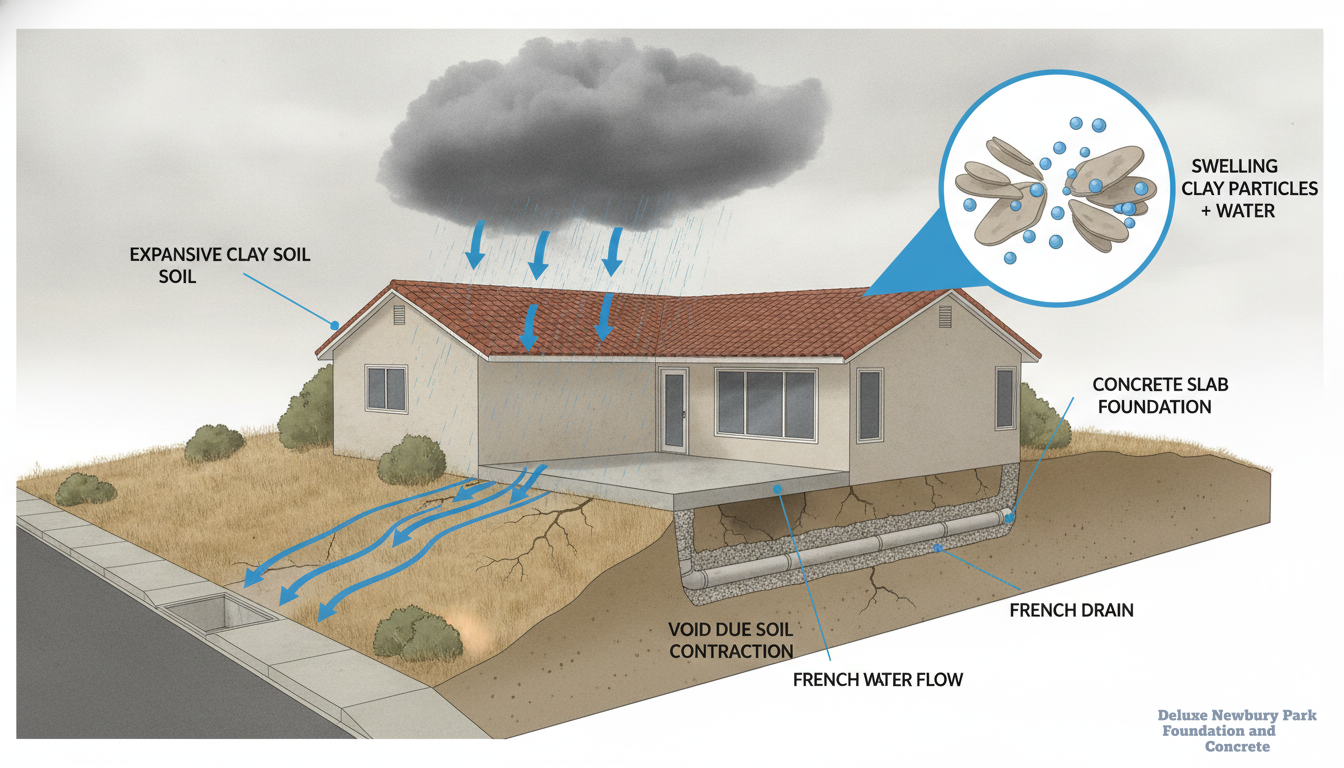
The Hidden Force Beneath Every Newbury Park Home
Most homeowners think about their foundation only when something visibly goes wrong — a crack appears, a door starts sticking, or a floor develops a noticeable slope. But the forces acting on a foundation in Newbury Park are at work every day, long before any symptoms appear. Understanding those forces is the first step toward protecting your home proactively rather than reactively.
The Conejo Valley, including Newbury Park and adjacent communities like Thousand Oaks, Westlake Village, and Moorpark, is characterized by a combination of soil type, topography, and climate that creates what geotechnical engineers call a high-shrink-swell environment. The implications for residential foundations are significant and deserve a detailed explanation.
Expansive Clay Soils: Newbury Park's Biggest Foundation Risk
The soils throughout much of the Conejo Valley are classified as expansive clays — specifically montmorillonite-rich formations that have an unusual capacity to absorb water molecules into their mineral structure. When these clays absorb moisture, they physically swell, exerting upward and lateral pressure on anything sitting above or beside them. When they dry out, they shrink and contract, withdrawing support from the structures above.
The volume change can be substantial — expansive clays in Southern California have been documented to change in volume by 10 to 15 percent between their wettest and driest states. For a home's foundation, this means that the bearing surface beneath the slab is literally moving up and down on a seasonal cycle, and doing so unevenly because different areas of the soil profile dry out and wet up at different rates depending on sun exposure, irrigation, tree roots, and slope position.
This is why so many Newbury Park homeowners notice their foundation symptoms worsen in late summer — after months of no rain, the soil has contracted maximally beneath the slab, creating voids and allowing sections to settle — and then see new cracking or heaving in late winter, when saturated clay swells against the foundation walls and slab edges.
Topography and Water Flow in the Conejo Valley
Newbury Park's position in the Conejo Valley means it receives runoff from surrounding hills and mountain slopes during rain events. Properties on or near hillsides — particularly in communities like Lake Sherwood — can receive significant volumes of water flowing toward and around their foundations during heavy winter storms. Even on flatter lots, roof drainage from gutters and downspouts concentrates large volumes of water around the foundation perimeter if not properly directed away.
When that water enters the soil immediately adjacent to or beneath the foundation, it accelerates the expansion cycle on the wet side while the dry side is still contracted. The differential movement — one portion of the foundation being pushed up while another is still settled — is a primary cause of diagonal cracking and floor slope.
Our foundation drainage solutions are specifically designed to intercept this water before it reaches the foundation. French drain systems installed at footing depth capture groundwater and redirect it to a safe discharge point. Surface catch basins handle roof runoff. Yard regrading creates positive slope away from the building envelope so sheet flow never pools against the foundation wall. These are not optional improvements — they are often the most cost-effective foundation protection investment available.
Seismic Exposure Adds Another Layer of Risk
The Conejo Valley lies within a seismically active region of Southern California. The Oak Ridge Fault runs through Ventura County, and the greater Los Angeles area contains numerous active fault systems capable of producing ground motion that stresses residential foundations. While most of Southern California's moderate seismic activity does not cause catastrophic foundation damage, it can open or widen existing cracks, cause minor differential settlement in already-vulnerable soils, and accelerate damage that was previously at a slow-developing stage.
This makes periodic foundation inspection especially valuable for Newbury Park homeowners — not just when symptoms appear, but as a routine check after any notable seismic event. Our inspection reports document the condition of your foundation at a specific point in time, giving you a baseline to compare against in the future and documentation for insurance purposes if seismic damage is ever claimed.
Moisture and Foundation Health: The Long Game
Water is the single most damaging agent acting on residential foundations over time. In concrete foundations, repeated wetting and drying cycles gradually open microcracking as the concrete expands and contracts. Water that infiltrates those cracks carries dissolved minerals and carbon dioxide that chemically attack the cement matrix in a process called carbonation, gradually reducing the concrete's alkalinity and leaving the embedded steel rebar vulnerable to corrosion.
When rebar corrodes, it expands — creating internal pressure that cracks the concrete from within and causes the characteristic rust staining and spalling seen on deteriorated foundations. This process is slow but essentially irreversible once advanced, which is why early foundation waterproofing is so much more economical than late-stage concrete repair.
Our waterproofing services address moisture at every level of the system. Exterior rubberized membranes block water at the foundation wall surface. Interior drainage channels and sump systems manage any infiltration that reaches the interior. Crystalline sealers applied to masonry block surfaces permanently fill pores and hairline cracks as moisture activates them. The right combination depends on your specific property's drainage pattern, foundation type, and existing moisture history — which is why every waterproofing job starts with a thorough site assessment.
What a Proactive Protection Plan Looks Like
Based on our experience serving homes throughout the Conejo Valley, we recommend a layered approach to foundation protection that addresses each of the risk factors described above:
- Start with a baseline inspection: A professional foundation inspection documents current conditions and identifies any active issues. For homes over 20 years old or recently purchased, this is the essential first step.
- Address drainage before anything else: If your yard grade directs water toward the foundation, or your downspouts discharge adjacent to the building, fixing drainage first prevents future damage from any repair you invest in today. Our drainage solutions in Newbury Park are designed for the valley's specific storm-flow patterns.
- Seal cracks promptly: Any crack wider than a hairline should be sealed with the appropriate material — epoxy for dormant structural cracks, polyurethane foam for active ones. Our crack repair service stops water infiltration and prevents further enlargement.
- Lift settled slabs before the voids grow: Soil voids beneath a settled slab panel grow over time as the concrete's weight continues to compress the loose material at the void edges. Our concrete leveling service using foam injection is most effective when voids are still small and the concrete above is still in good condition.
- Apply waterproofing as a final layer of protection: Even with excellent drainage, a waterproof membrane provides redundant protection against moisture that reaches the foundation wall or slab edge. Combine it with crack repair for a fully sealed system. Visit our foundation waterproofing in Newbury Park page for details on exterior and interior options.
Serving the Entire Conejo Valley and Beyond
Deluxe Newbury Park Foundation and Concrete is headquartered in Newbury Park at 3255 Old Conejo Rd, Suite 111, and serves homeowners throughout Ventura County and the eastern edge of Los Angeles County. Whether you are in Newbury Park, Thousand Oaks, Westlake Village, Lake Sherwood, Somis, or Moorpark, our team brings the same depth of local knowledge and commitment to honest assessment to every job.
We are available Monday through Sunday, 8:00 AM to 6:00 PM. Call (805) 554-0860 or email [email protected] to schedule your foundation inspection or consultation. The best time to address a foundation problem is always before it gets worse — and with Newbury Park's soils, it almost always will if left alone.